
Find out what we can do for your school’s marketing
How to Write School Copy That Compels Parents
The golden rule: borrow the parents’ words
When a parent writes “my daughter finally feels known,” that is better than anything a copywriter could invent. It is specific, it is emotional, and it is exactly how the next parent thinks and searches.
So the job is not to invent clever lines. It is to collect, sort and reuse the phrases parents already say. Start a simple “parent phrase bank” (a spreadsheet is fine) and add to it as you work through the five sources below. Every headline, ad and email subject line you write afterwards starts from that list.
Every dollar has to work harder now
Enrolment competition has intensified across most markets. Independent, Catholic and government schools are increasingly competing for the same pool of prospective families — many of whom are making decisions earlier, with more information, and higher expectations than ever before.
That narrows the margin for inefficient spend considerably. Budget sitting in channels that can’t demonstrate attributable results isn’t just wasteful — it’s opportunity cost. Every dollar not working is a dollar not reaching a family who’s actively researching their options right now.
Source 1: Reviews of your school and your competitors
Start with Google and Facebook reviews. Read yours, then read the two or three schools parents are most likely to compare you with.
Look for the emotional language: “such a caring environment,” “my child loves going to school every day,” “they’ve developed a real curiosity for learning.” Copy the exact phrases into your phrase bank. The ones that keep repeating are the ones that matter most.
Also read the lukewarm and negative reviews of other schools. They show you what parents wish schools did better, and if you do it well, that is a message worth leading with.
Source 2: Surveys of families who didn’t enrol (and those who did)
Families who enquired and then chose another school can tell you what really tipped the decision. Not everyone will reply, but even five or six honest answers will change how you write.
Keep it to two minutes and send it straight after you learn they’ve gone elsewhere. Something like: “Thanks again for considering us. If you have two minutes, we’d love to know what shaped your decision so we can do better for future families.”
Three or four questions are plenty:
- What were you looking for in a school?
- What influenced your final choice?
- What could we have done better?
- What nearly made you choose us?
Ask new families too, about six weeks after they start: “What made you choose us?” Their answers are testimonial gold.
Source 3: Online forums and parent groups
Parents ask for school recommendations in local Facebook groups, community forums and Reddit threads. The replies (“we chose X because…”) show you how parents justify a decision in their own language.
Set up a Google Alert for your school’s name and for phrases like “best primary school in [your suburb]” so you see new conversations as they appear. Read and learn; don’t jump in with a sales pitch, and follow each group’s rules.
Source 4: School tours and open days
If you’re the marketer and you don’t run tours, do one a month. Standing in the room with parents is the fastest way to hear what they care about, in real time.
Keep a running log of every question. The common ones usually include:
- Academic results and pathways beyond Year 12
- Fees and what is (and isn’t) included
- Class sizes and how students are grouped
- Wellbeing, pastoral care and how bullying is handled
- Bus routes, before and after school care
- Technology and phone policies
Every question asked on a tour is a question being typed into Google by a parent who didn’t make it to a tour. Answer them on your website, in your brochures and in your emails.
Source 5: Your own website and enquiry data
Your data holds the parents’ words too. Check:
- Google Search Console, for the queries that bring people to your site
- Your website’s internal search, if it has one
- Enquiry form messages and live chat transcripts
- The top ten questions your admissions team hears on the phone
If the same question comes up again and again, your copy isn’t answering it clearly enough.
Turning what you hear into copy that works
Once your phrase bank has a few dozen entries, writing gets much easier. Use this four-step method.
- Sort the phrases into themes. Typical ones are belonging, wellbeing, learning, pathways and practicalities. The biggest themes become your key messages.
- Lead with the outcome for the child, not the feature. Parents don’t buy a “pastoral care program.” They want a child who is known and safe.
- Write to “you” and “your child.” Count the times you write “we” and “our.” If it outnumbers “you,” rewrite.
- Back it with something specific. A real example, a number, a student story or a teacher’s name does more than an adjective.
Here’s how that changes the copy:
Before: school-centred
We offer a comprehensive pastoral care program.
After: parent-centred
Your child will have an adult who knows them by name and notices when something’s off.
Our state-of-the-art campus has modern facilities.
Space to build, perform, play and try new things, so your child can find what they love.
Small class sizes.
Classes small enough for teachers to know how your child learns best.
Enrol now for 2027.
Book a tour and see what their Tuesday could look like.
A few finishing tips:
- Use tour questions as headlines. “What does the move to Year 7 look like?” works better than “Transition programs.”
- Use review language as language, not as a quote. If you want to publish a parent’s exact words as a testimonial, ask their permission first.
- Only promise what you deliver. Parents compare what you say with what they see on the tour, and any gap costs you trust.
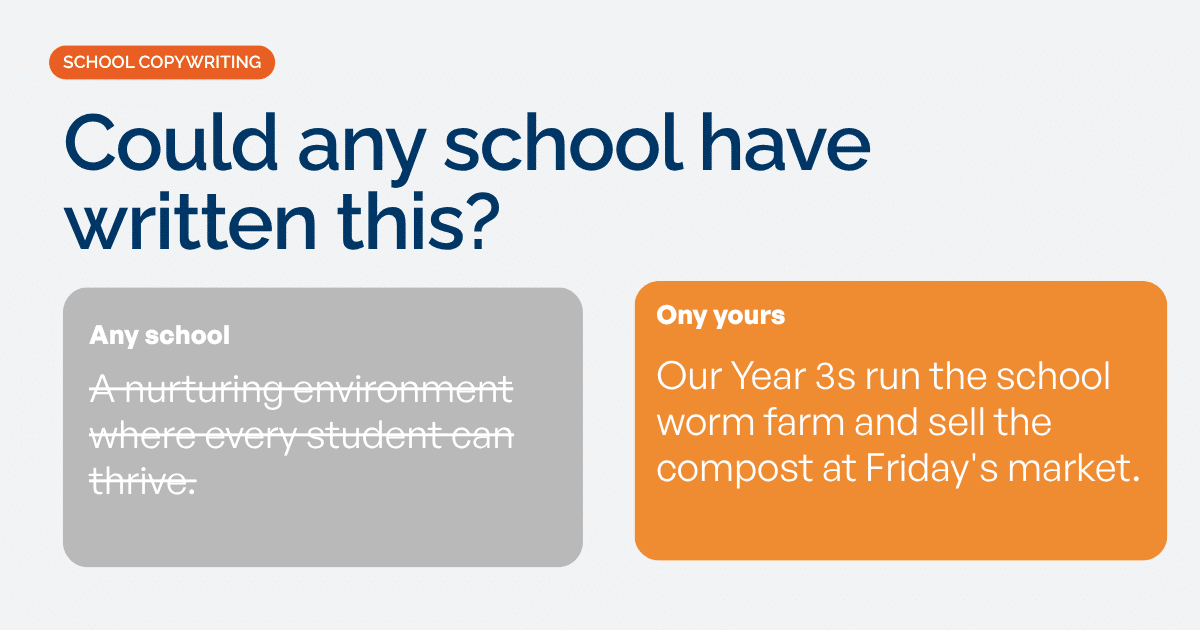
- Be a little less expected. The education sector is full of the same phrases (“nurturing,” “excellence,” “holistic”). Parents’ real words are more vivid than any of them.
Your school copy checklist
Before anything goes to print or live on your website, check that it:
- Uses at least one phrase straight from your phrase bank
- Opens with the benefit to the child or family, not the school
- Says “you” and “your child” more often than “we” and “our”
- Answers a question that has actually been asked on a tour or in an enquiry
- Includes one specific proof point (a story, a number, a name)
- Ends with one clear next step, such as booking a tour, downloading the prospectus or joining the open day
Delivering Exceptional Outcomes
#1 Digital Marketing Agency and Community
Need a quote for an upcoming campaign or to learn what’s possible? Get in touch with us for a friendly chat and find out how we can help you.